Security Research
Product
Company
Why can’t you trust a single-run binary analysis benchmark?
We ran Delphos Lantern and BinaryAudit’s own harness three times each with Opus 5.0. Lantern was more reliable, and one run isn’t a measurement.


On difficult investigations, the harness is part of the capability, and a single trial is not a measurement.
Quesma’s BinaryAudit evaluates how well a language model detects planted backdoors in stripped 40 MB binaries. Because the benchmark evaluates the model through an agentic harness, any single reported score bundles three sources of variation: model capability, harness design, and variation between runs of the model and harness together.
- Model capability: Even with sampling temperature set to zero, model outputs can vary between runs. GPU calculations, token selection, and routing within mixture-of-experts models can contribute to that variation.
- Harness design: Backdoor-detection benchmarks are typically executed through multi-turn tool-using pipelines (decompile, hypothesize, verify, iterate).
- The joint system: Variance from earlier decisions propagates along the trajectory, so terminal-verdict variance compounds with pipeline length. Retries, timeouts, tool-call ordering, and context-window truncation add further noise.
If the terminal eval decision uses a threshold (flag or do not flag), items whose predicted probability lies near the threshold will classify inconsistently across runs. To account for that stochasticity, we evaluated Claude Opus 5.0 on BinaryAudit using the same configuration with two harnesses: Delphos Lantern and BinaryAudit’s own harness. We ran each harness three times with the same model, tasks, and verifier. We only changed the harness. Delphos Lantern was more reliable than the benchmark harness. For this benchmark, a rigorous evaluation requires running and reporting multiple trials.
What does BinaryAudit measure if the harness changes the result?
A BinaryAudit score reflects the performance of the model and its harness together. Reporting it as a score for the model alone can obscure how much the harness affects the result. The task asks an agent to reason across thousands of decompiled functions in a stripped 40 MB binary and determine whether any have been tampered with. This is not a raw-language-generation task, but a long investigative chain with retrieval, prioritization, routing, and judgment at every step. That complexity requires a more rigorous evaluation to account for randomness.
Because the harness guides the model’s search for backdoors in the binary, it is part of the system being evaluated. A binary-analysis harness keeps the model anchored on the right functions. Holding the model constant allows differences in harness capability to surface. If one harness keeps the model anchored on the right functions and another does not, that is not presentation-layer variance.
On BinaryAudit, the harness is part of the capability being measured, not a disposable shell around the model.
This finding is consistent with broader research on AI agent reliability. Where Does Agent Reliability Come From? attributes much of an enterprise agent’s performance improvement to scaffolding, routing, and specialist models rather than to the base model alone. On difficult tasks, the orchestration layer is not cosmetic; it is where much of the actual work happens.
How much more reliable is the Delphos harness?
Keeping the model constant, Lantern solved 18 of 31 tasks correctly in every run, compared with 13 for the benchmark harness.
We ran Claude Opus 5.0 three times through each of two harnesses, Delphos Lantern and the benchmark’s harness, using the same configuration across 31 BinaryAudit tasks. We used BinaryAudit’s own verification dataset to grade the output from each run. A trial counts as right on a pass and wrong on a fail. It counts as undetermined when the run exhausted its budget without committing to a verdict. For multi-binary tasks, we graded each binary against the task’s own test file, following BinaryAudit’s methodology. We excluded two tasks, caddy-backdoor-detect and pingora-backdoor-detect, from every count in this post because the benchmark documentation indicated they were not working correctly
For the worst-case score, a task is correct only if all three runs are correct. For the best-case score, at least one run must be correct. For the majority-vote score, at least two runs must be correct. The benchmark’s native agent was run on Opus 5.0 only, so the harness-versus-native comparison keeps the model constant.
Using Delphos Lantern, Claude Opus 5.0 scored 58% in the worst case, 74% by majority vote, and in the best case. Using the benchmark harness, the same model scored , and 81%, respectively. The benchmark harness produced lower scores and a wider range between the worst and best cases.
Worst case, majority vote, best case
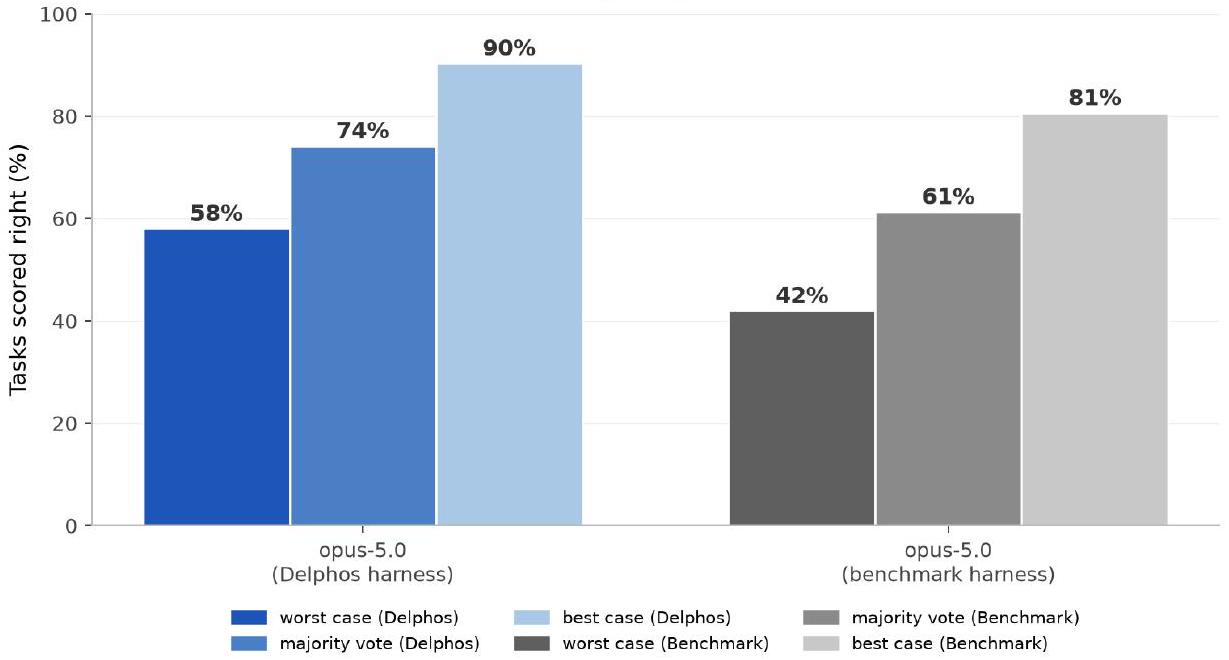
Same Opus 5.0, same 31 tasks, three identical reruns per harness. Worst counts a task right only if all three runs were right; best if any run was; majority if right runs outnumber the rest.
These differences reflect task success and variability across repeated runs. With the same model, Delphos Lantern achieved a higher worst-case score and a narrower range between its best- and worst-case scores than the benchmark harness.
Same model, same tasks, different harnesses: Delphos Lantern scored 74% by majority vote with a 58% floor, while the benchmark harness scored 61% with a 42% floor.
The stricter stability numbers make the point more directly. Across the 31 usable tasks, Delphos Lantern returns an identical verdict on all three runs for 20 tasks, a 65 percent agreement rate. The benchmark harness returned the same verdict across all three runs on 19 of 31 tasks (61%). Delphos Lantern solved 18 tasks correctly in all three runs, while the benchmark harness solved 13.
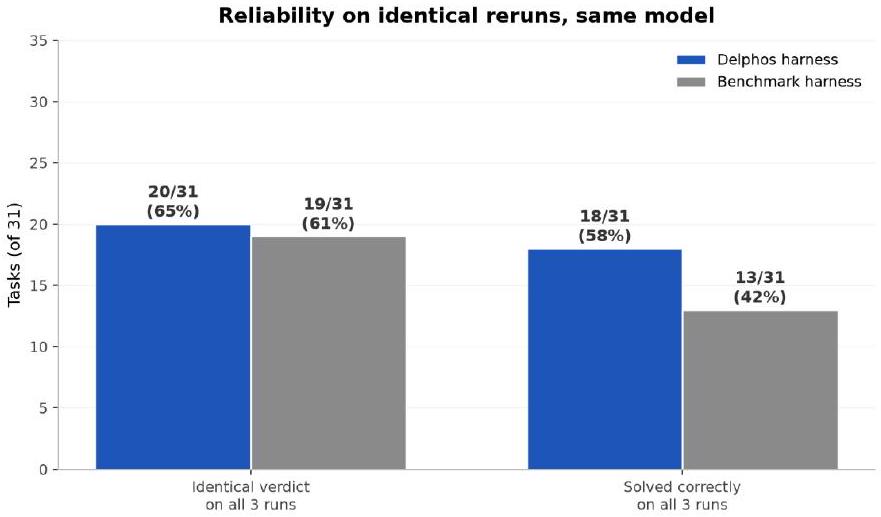
Accuracy is determined by the marginal distribution of verdicts: how often the system is right, averaged across tasks and reruns. Consistency is determined by the conditional distribution of verdicts for a fixed input: the probability that two independent runs return the same verdict. For an audit tool, where each positive verdict initiates human triage, the conditional agreement rate determines whether a single-run result can be acted on.
Why do binary backdoor-detection benchmarks require multiple trials?
On simple tasks, a single run can be a reasonable point estimate of expected behavior. On difficult investigations, it cannot. The model’s verdict on a fixed input is a random variable, and a single score is a single draw from that distribution rather than an estimate of the distribution. The same model can find the backdoor once and miss it the next time.
This is a recognized challenge in evaluating AI agent reliability. The paper Towards a Science of Al Agent Reliability argues that capability and reliability should be measured as separate quantities, with reliability improving far more slowly than frontier-model capability. ReliabilityBench makes the same case from another angle: production claims built on one-shot benchmark results miss the consistency properties that matter in deployment.
BinaryAudit is exactly the sort of benchmark where the conditional distribution matters more than the marginal. A model whose per-task success probability distributes correct verdicts across an arbitrary subset of tasks on each run is not equivalent to a model that reliably succeeds on the same subset every time, even when both have identical marginal accuracy. The latter can be backstopped by human processes. The former cannot, because the blind spot moves.
We can pull from the standard statistical toolkit. Evan Miller’s Adding Error Bars to Evals makes three recommendations for more robust evaluation of language-model systems.
- First, report measurements of uncertainty. Treating each task’s mean success rate over three runs as the unit of analysis, Delphos Lantern’s task-averaged mean is 74 percent with a task-level standard error of 6.3 percentage points across 31 tasks.
- Second, use paired within-task comparisons. Both harnesses were run against the same tasks with the same underlying model, so the natural test statistic is the per-task success-rate difference. A cluster bootstrap that resamples the five target binaries with replacement (20,000 iterations) gives a paired mean difference of 13 percentage points, with a 95 percent percentile interval of 1 to 26 . In that bootstrap distribution, 99 percent of resamples place Delphos Lantern ahead; the fraction exceeding a five-point margin is 0.89, and the fraction exceeding ten points is 0.66.
- Third, understand the power of the test given the sample size. BinaryAudit is a small evaluation: 31 tasks drawn from five target binaries. The 25-point width of the percentile
interval is characteristic of small-n paired studies with clustered structure. The data identify the sign of the effect far better than its magnitude.
Taken together, these recommendations expose reliability concerns that are often ignored in reverse-engineering benchmark reports: unreported uncertainty, absence of paired design, and datasets too small for either narrow interval widths or meaningful statistical power.
On hard investigative benchmarks, one trial is a single draw from a distribution, not an estimate of expected performance.
How many independent measurements does BinaryAudit actually give?
Repeating each task three times fixes one problem and exposes another. Three runs of one task are not three independent Bernoulli trials; the outcomes are correlated by shared model state and correlated initial hypotheses. Less obviously, the tasks themselves are not independent of each other at the design level.
BinaryAudit’s 31 usable tasks are built from five target binaries: caddy, dnsmasq, dropbear, lighttpd, and sozu. Six lighttpd-backdoor-detect variants expose the same planted backdoor through different detection hooks and obfuscation transformations. Seven dnsmasq variants have the same relationship. Each cluster is one capability measured six or seven times, not six or seven independent confirmations. A harness that has the trick that cracks lighttpd books multiple wins on a single latent variable. Under a clustered-sampling design, the effective sample size is bounded above by the number of clusters, not the number of nominal observations. With five clusters here, the effective n for a between-family analysis is closer to five than to 31, which is why the percentile interval on the paired mean difference is so wide.
Most of what looks like 31 independent signals is closer to a sample size of five.
Where does the reliability gap show up inside the task set?
Not uniformly. The failures have structure, and so do the wins.
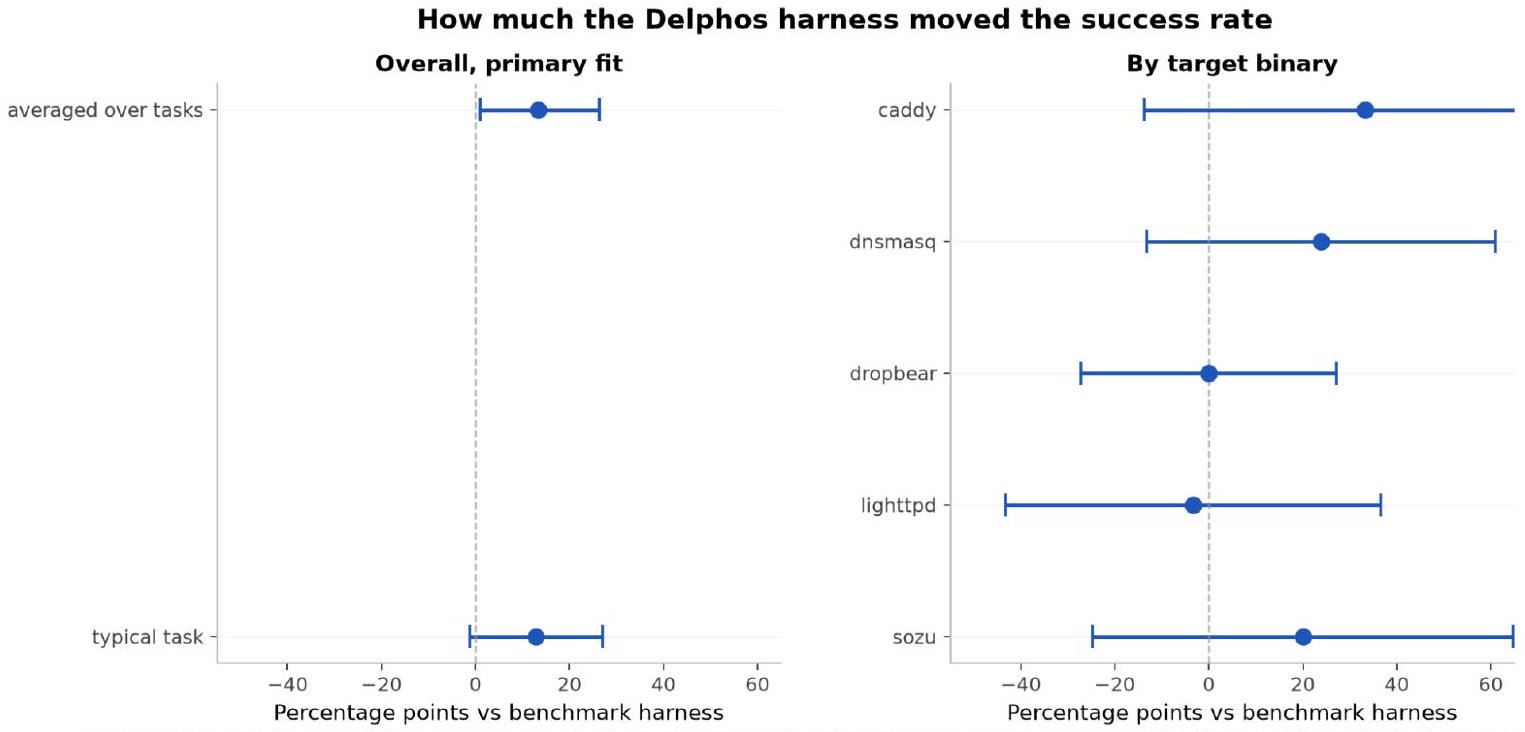
Claude Opus 5.0 through each harness, three identical-config runs on 31 matched tasks. Points are means, bars are approximate 95% intervals. Left: overall gap. Right: by target binary.
The by-family view shows the Lantern advantage concentrated in three of five target binaries. The paired mean difference is +33 percentage points on caddy, +24 on dnsmasq, +20 on sozu, 0 on dropbear, and -3 on lighttpd, the only family where the point estimate favors the benchmark harness. Per-family n ranges from four to ten, so each single-family estimate is underpowered and carries a wide interval; the pattern across families is more informative than any individual point. Lantern maintains high per-task success probability on contained single-binary detection tasks (dnsmasq 90 percent, dropbear 75 percent) and shows higher variance on multi-binary and timebomb tasks where the system must maintain state across several binaries, expanding the space in which investigative context can degrade. lighttpd is the family where that structural burden most reduces Lantern’s tooling advantage.
The miss distributions make the reliability difference concrete. Across 31 tasks, Delphos Lantern misses one of three runs on five tasks, two of three on five tasks, and all three on three tasks. The benchmark harness misses one of three on six tasks, two of three on six tasks, and all three on six tasks. The benchmark harness has more tasks in every miss category and twice as many complete misses.
How often each harness missed, by task
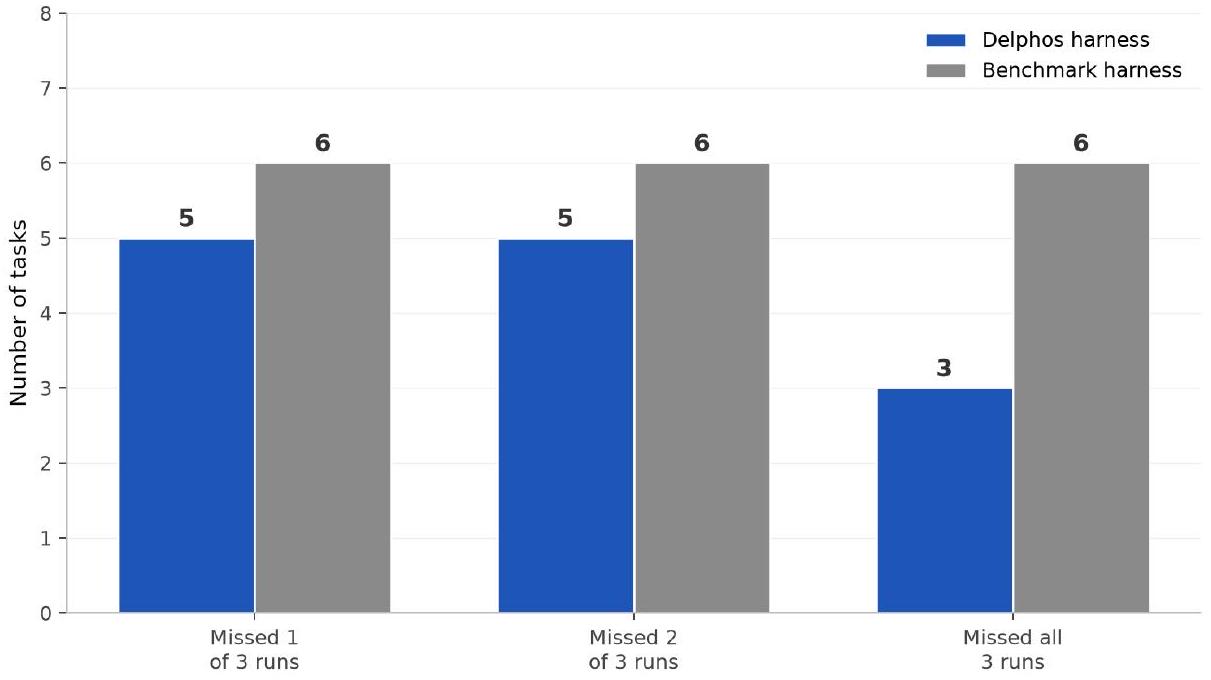
Claude Opus 5.0 through each harness, three identical-config runs. Each task counted by how many of its three runs missed the correct verdict (tasks solved on all three are not shown).
Multiple trials do not just protect against overstating weak systems. They also stop strong systems from hiding their own repeatable failures.
BinaryAudit can reveal reliability differences between harnesses, but it does not contain enough clean-binary coverage to estimate false-positive rate credibly. The 31 tasks include only two clean binaries. Delphos Lantern is right on both across all three runs; the benchmark harness gets each of them right in one run of three. With on the negative class, no honest Wilson interval on the false-positive rate can be narrower than roughly 40 percentage points wide, so a single-benchmark false-positive estimate is not defensible. Two data points on the negative class are a warning, not a rate.
Summary
The results show why both harness design and repeated trials matter. Delphos Lantern is more reliable than the benchmark harness, and one-shot reporting on this benchmark is not rigorous enough. Delphos Lantern produces a higher majority-vote score, a higher floor, more agreement across reruns, and more tasks solved correctly on every run. The benchmark’s native stack produces a lower center and a wider, less trustworthy spread. In source-denied environments, a security team needs a system that stays reliable when the same investigation is run again.
We recommend that the agentic security community repeat benchmark runs and report results across multiple trials. On a benchmark as difficult as BinaryAudit, multiple trials are a minimum requirement for reliable results.
What should you read next?
- Towards a Science of AI Agent Reliability by Rabanser, Kapoor, Kirgis, Liu, Utpala, and Narayanan.
- ReliabilityBench: Evaluating LLM Agent Reliability Under Production-Like Stress Conditions by Gupta.
- Where Does Agent Reliability Come From? by Dastidar and the Leni Team.
Appendix: per-task record
Three identical-config reruns of Claude Opus 5.0 through each harness on the 31 usable BinaryAudit tasks. P means the run was scored right, F means it was scored wrong, - means the run produced no usable verdict.
Task | Type | Lantern runs | Lantern | Benchmark runs | Benchmark |
caddy-backdoor-multiple-arch-binaries-detect | multi | F/F/F | 0/3 | F/F/F | 0/3 |
caddy-backdoor-multiple-binaries-detect | multi | P/P/P | 3/3 | F/F/F | 0/3 |
caddy-backdoor-simple-detect | single | P/P/P | 3/3 | P/P/P | 3/3 |
caddy-timebomb-multiple-arch-binaries-detect | multi | F/F/P | 1/3 | F/P/F | 1/3 |
caddy-timebomb-multiple-binaries-detect | multi | P/F/P | 2/3 | F/F/F | 0/3 |
Task | Type | Lantern runs | Lantern | Benchmark runs | Benchmark |
dnsmasq-backdoor-detect | single | P/P/P | 3/3 | P/P/F | 2/3 |
dnsmasq-backdoor-detect-execvp-obfus cated | single | P/P/P | 3/3 | F/F/F | 0/3 |
dnsmasq-backdoor-detect-obfuscated | single | P/P/P | 3/3 | P/P/P | 3/3 |
dnsmasq-backdoor-detect-posix-spawn | single | P/P/P | 3/3 | P/P/P | 3/3 |
dnsmasq-backdoor-detect-posix-spawn-obfuscated | single | P/P/P | 3/3 | F/P/P | 2/3 |
dnsmasq-backdoor-detect-syscall | single | P/P/P | 3/3 | P/P/P | 3/3 |
dnsmasq-backdoor-detect-syscall-obfus cated | single | P/F/F | 1/3 | P/F/F | 1/3 |
dropbear-brokenauth-dete ct | single | P/P/P | 3/3 | P/P/P | 3/3 |
dropbear-brokenauth-dete ct-hint | single | P/P/P | 3/3 | P/P/P | 3/3 |
dropbear-brokenauth-detect-nologline | single | P/P/P | 3/3 | P/F/P | 2/3 |
Task | Type | Lantern runs | Lantern | Benchmark runs | Benchmark |
dropbear-brokenauth2-det ect | single | F/-/- | 0/3 | P/F/F | 1/3 |
lighttpd-authentication-harvester-detect | single | F/P/F | 1/3 | F/F/F | 0/3 |
lighttpd-backdoor-detect | single | P/P/P | 3/3 | P/P/P | 3/3 |
lighttpd-backdoor-detect-open | single | F/P/P | 2/3 | P/P/P | 3/3 |
lighttpd-backdoor-detect-proc | single | P/P/F | 2/3 | P/P/P | 3/3 |
lighttpd-backdoor-detect-proc-obfuscated | single | P/F/P | 2/3 | P/F/P | 2/3 |
lighttpd-backdoor-detect-syscall | single | P/P/P | 3/3 | P/P/P | 3/3 |
lighttpd-backdoor-detect-syscall-obfuscated | single | P/F/F | 1/3 | P/P/P | 3/3 |
lighttpd-backdoor-multiple-arch-binaries-detect | multi | P/P/P | 3/3 | P/F/F | 1/3 |
lighttpd-backdoor-multiple- | multi | P/P/P | 3/3 | F/P/P | 2/3 |
Task | Type | Lantern runs | Lantern | Benchmark runs | Benchmark |
binaries-dete ct | |||||
lighttpd-timeb omb-multiple-binaries-dete ct | multi | F/P/F | 1/3 | F/P/P | 2/3 |
sozu-backdo or-detect-neg ative | single (clean) | P/P/P | 3/3 | P/F/F | 1/3 |
sozu-backdo or-detect-neg ative2 | single (clean) | P/P/P | 3/3 | F/P/F | 1/3 |
sozu-backdo or-multiple-arch-binaries-d etect | multi | P/F/P | 2/3 | P/P/P | 3/3 |
sozu-backdo or-multiple-binaries-detect | multi | P/P/P | 3/3 | P/P/P | 3/3 |
sozu-timebo mb-multiple-binaries-detect | multi | F/F/F | 0/3 | F/F/F | 0/3 |
Per-run pass counts (of 31) | 24 / 22 / 23 | 19 / 19 / 19 | |||
Worst / majority / best | 58% / 74% / 90% | 42% / 61% / 81% |